Generative AI and the Copyright Enforcement Issue
The process of copyright enforcement more or less works like this:
You’re on Tiktok doom-scrolling and you come across an unreleased song leak. It’s catchy and you stay to listen. 30 seconds in you’re nodding your head along and making this face (as one does when listening to new rap music).

You go to the comments to figure out what the song is called and there’s a wall of comments saying “AI generated”. You like it anyway, look it up on Spotify, and add it to your playlist. 1 week later it’s removed from Spotify. Last year Ghostwriter977 went viral for publishing “Heart On My Sleeve,” using a generative model to deepfake Drake’s voice. The song got 20 million views over a few days.
In another case, rapper Juice WRLD’s voice was generated by AI over a human-made track and even comments are stunned at the voice model’s output.
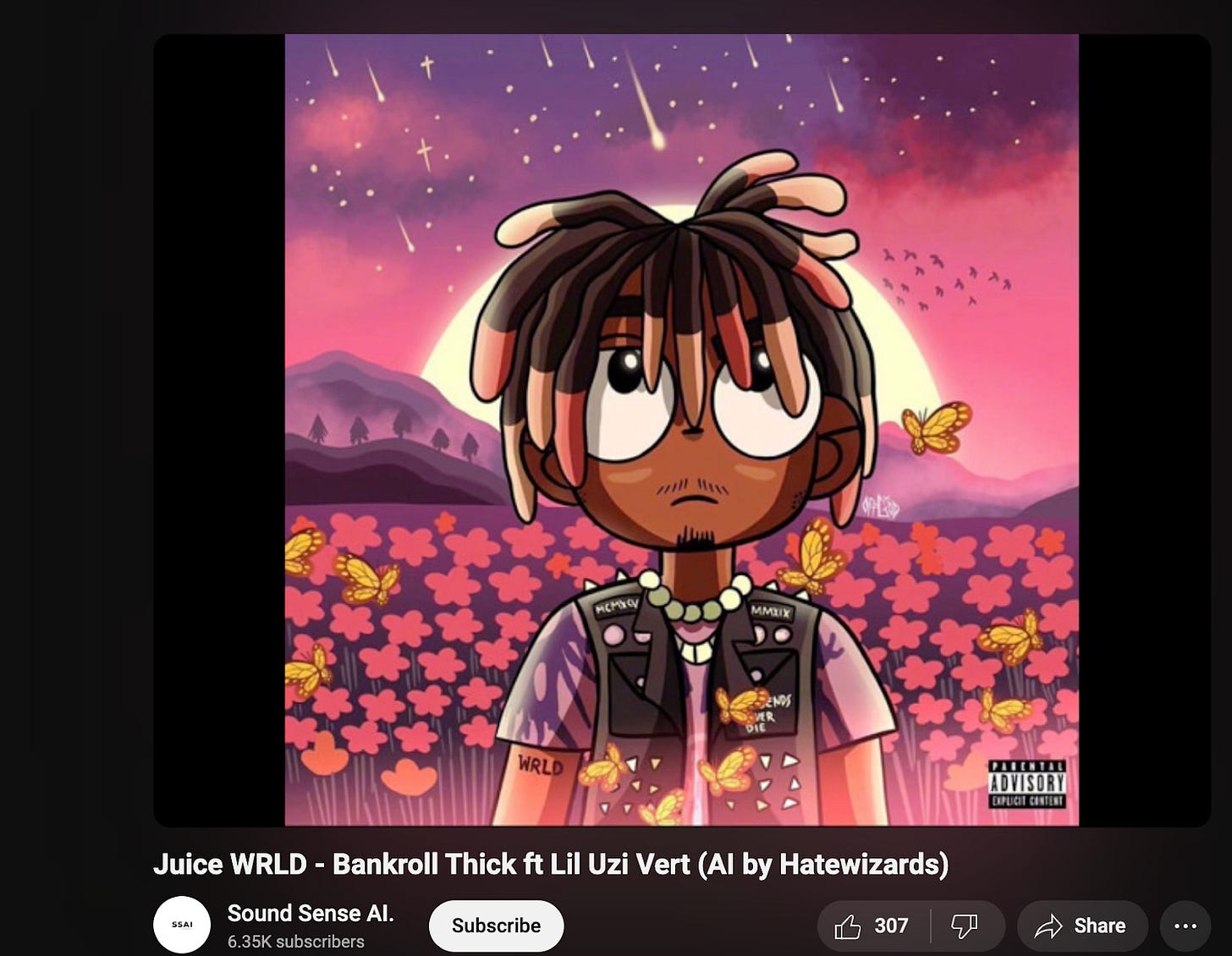
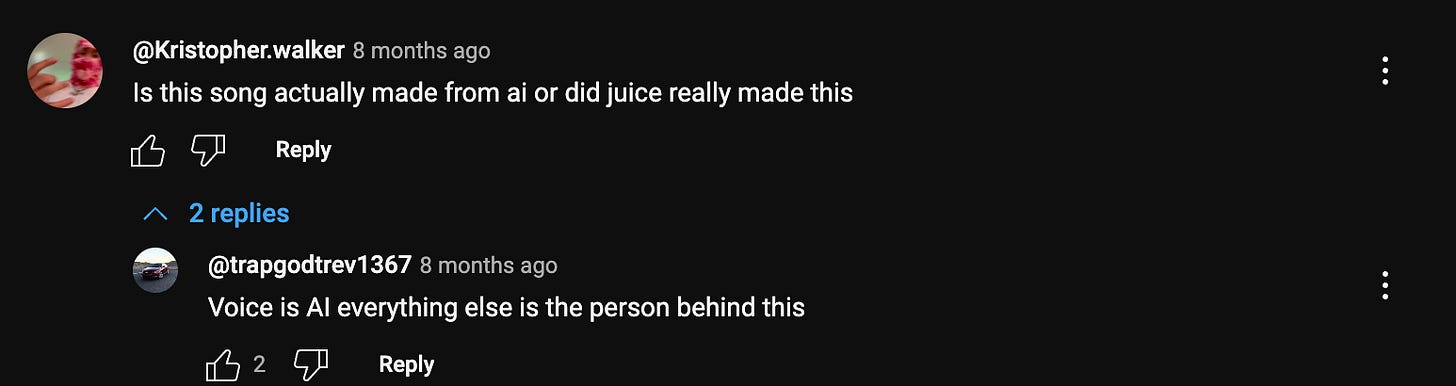
These instances are no longer far and few between, but daily occurrences. AI music deep-faking can and will happen to every popular artist in the next decade and beyond.
What does fair use mean in a world of gen-AI?
Artists (and sometimes their labels1) own the rights to a composition, likeness, and artist IP. That means, nobody else can use it outside of a somewhat narrow but now contentious ‘fair-use’. ‘Fair use’ basically means, what are the ways you’re allowed to use and create with my IP or copyrighted work without me needing to license it to you? This has become controversial because of gen-AI and the clash between what are called ‘derivative works’ and originals. Derivative works are ‘inspired’ and borrow some or all parts of the original work.
Artists don’t very much like the use of their work, their face, their voice, or anything really without their permission.
When SkibidiBob69 makes a Drake song and publishes it on Spotify, understandably Drake and his label aren’t too happy about it. This isn’t because he’s losing some material amount of money to AI deep fakes today, but instead because there’s severe brand risk in letting unknown actors run wild with his IP, especially as generative models become higher fidelity and the difference between artist-made and gen-AI music goes to zero. AI Drake might rap about not liking the Toronto Raptors (or something much worse) and Drake might not like that.
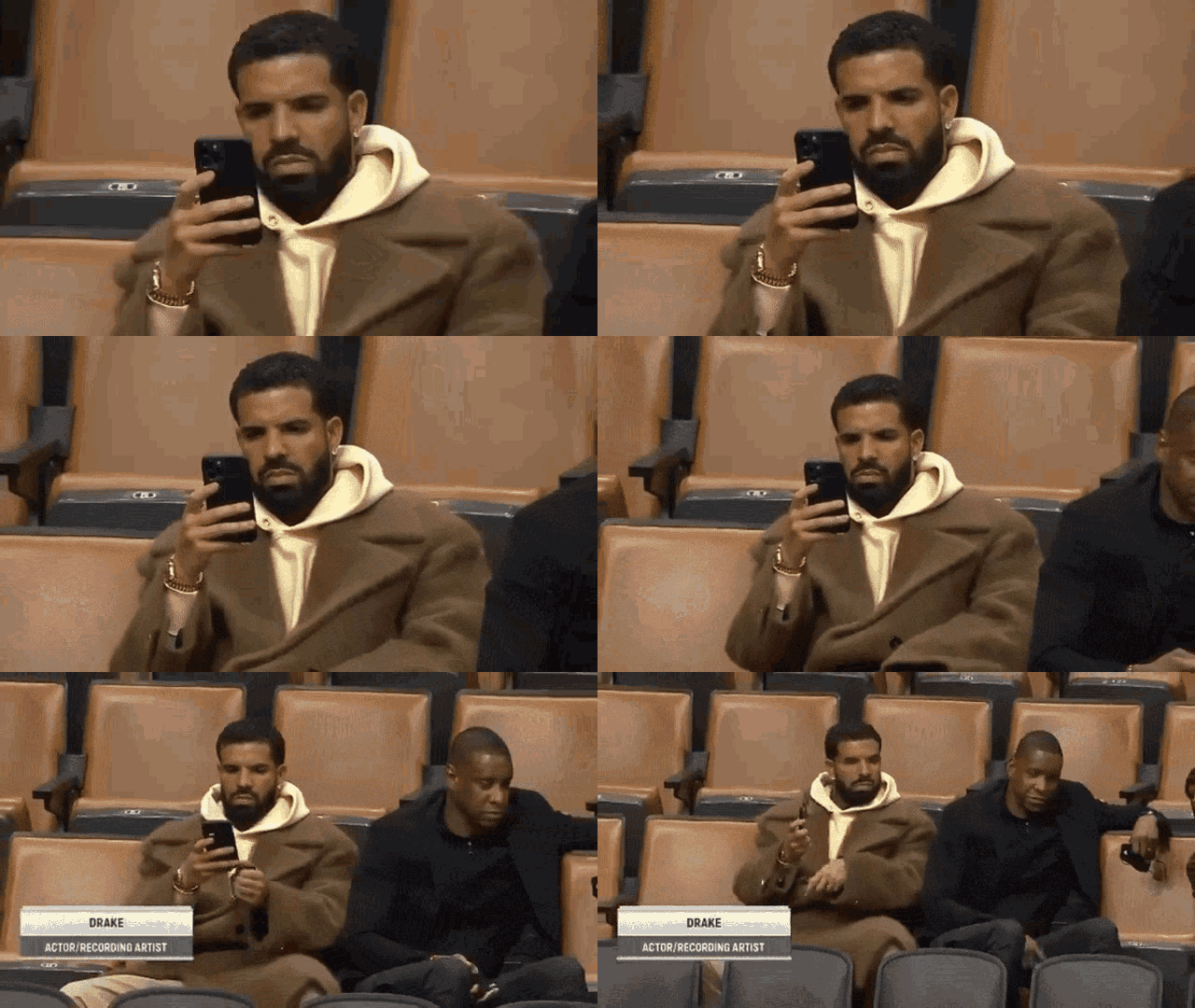
Then Drake or OVO’s or Sony’s very well-paid legal team will send a strongly worded cease-and-desist letter to Spotify to say something along the lines of “Hey, this song (which I didn’t make) is using my voice and likeness on your platform and that is not a fair use of my IP or copyright. This violates the fair use doctrine and is damaging to me. if you don’t remove it I will sue you.” Spotify will remove it, citing the Digital Millennium Copyright Act (DMCA) and then 2 weeks later they’ll do it all over again with another AI-generated song.2
To be clear, this is already happening -- Universal Music Group (UMG), Sony Music Entertainment, and Warner sued Anthropic, a leading foundation model provider, as well as two generative music companies Suno and Udio -- both of whom trained their generative models on unlicensed, copyrighted music files. The generative music case is worth talking about in a little bit more depth.
Events:
Universal, Sony, and Warner sued Suno and Udio for copyright infringement, saying they copied artist music to train AI.
Suno and Udio use a database of publicly available music on the internet to train their models. Some of (a lot of) this music is copyrighted by various publishers. Both companies claim this to be ‘fair-use’.
Labels take that and say “aha” so you did violate copyright by using copyrighted work.
The companies respond “well our outputs are novel and net-new; we have safety measures in place to prevent reference of individual artists and tracks”.
Labels try to prove that Suno was violating copyright by prompt-engineering with very specific instructions to try to reproduce an existing song and they succeed. They say “Aha -- caught you, here’s the proof you stole artist work, because otherwise how would this be possible?”
Suno says “We analyze musical similarities and features to imitate a style or genre of work. There are hundreds of versions of a song that the model may be trained on. If anything, you violated copyright law and terms of service by prompting to get something so similar to a pre-existing work”.
Historically, the record label industry has been on the wrong side in most issues of technology: recording technology, synthesizers, drum machines, digital sampling, and digital streaming. I’m not a lawyer, but I think labels are on the wrong side again based on two key legal facts:
There’s legal precedent for the use of copyrighted work within technical research as ‘fair-use’. In Authors Guild v. Google, Inc and Kelly v. Arriba Soft Corp, courts decided that copying for internal, back-end processes—like analyzing or indexing—was legal because the final output didn’t infringe on any copyrights and the intermediary copy of the copyrighted work was never made publicly available.
Net-new outputs: The output that Suno spits out is net-new and not a direct copy or sample of copyrighted works used in training. The U.S. Copyright Act (17 U.S.C. § 114(b)) supports this view and basically says that if a new sound simulates or imitates an existing one, it may not infringe on copyright if it was independently created. This is best supported when the new work is ‘transformative’ in purpose (meaning it has turned into something new in terms of utility, meaning, or end-use).
Good news for aspiring founders -- where there’s an expensive problem, there’s usually a solution that someone needs.
Opportunity for a Startup
Digital service providers have the ultimate responsibility in preventing willful or implicit copyright infringement. Otherwise they can be held legally liable for damages to the artist -- that means they must impose safeguards and controls to prevent this from happening. If you try to prompt chatGPT to make images that look like your buddy, it will say something like “I can’t do this, but here’s a person that looks sort of vaguely not-really-at-all like who you asked for” because of IP and likeness concerns.
In a music streaming platform’s case, the precise problem is that someone can claim to be John Doe, but publish music that sounds like Drake. If you’re Spotify and 100,000 - 120,000 songs3 get published every day, this is a very difficult and expensive engineering problem. Even with a proper notice and take-down process (the way in which labels report DMCA violations), scale creates problems that manual policing cannot fully address. To be clear, these companies don’t care about stopping AI-music at large (in fact they may encourage it to drive up streaming engagement and new content publication), just AI-music that infringes on artist copyright.
This is an interesting case study in leverage: Spotify has the plurality of global stream-share at 31% (Apple Music is next at ~14%)4, so Drake can’t quite pull off Spotify and lose half his streaming audience for the foreseeable future. That would make fans very upset and Drake’s bank account (slightly) less large. The bigger consequence is that Spotify, not wanting to violate its licensing deals with record labels and avoid drawn-out court proceedings, would probably rather pay for a solution5 but short of that they’ll work on solving it themself. The same goes for Apple Music and other music digital service providers (DSPs).
There’s probably an opportunity somewhere in this value chain for a startup to develop policing mechanisms to detect and remove AI-generated deepfake music (and other content mediums). This solution might be sold to a DSP directly for policing copyright on the platform or bought as a value-added service from the distributor before it ever gets to a platform.
Alternatively, a startup may lean into generative AI co-creation and help create novel licensing and permissioning structures with royalty sharing / fair attribution to allow the coexistence of generative music and original artist work like artist Grimes has suggested here. This path seems a lot more ambiguous and would likely require co-development with labels and their artists (I’m generally skeptical of labels being drivers of new technology and IP standards adoption).
There are a couple companies & nonprofits working to solve this problem from different points of view and I’m excited to see others tackle the problem: Prorata, Tollbit, Spawning, Ircam Amplify, Kits, Vermillio, CreatedByHumans.
If you’re building in this space or have thoughts / questions on this piece, please reach out: jasmans625@gmail.com
Masters and publishing rights are a longer discussion that we won’t cover in this post.
This process might be easy for Drake because of his army of resources. For less resourced artists, there’s a lot of fly-swatting to come with generative-AI deepfake music attempts.
https://insights.vaizle.com/spotify-statistics/#:~:text=14.,have%20been%20uploaded%20every%20month.
The solution has to work without false positives.
Originally published on Nondescript.